The Denver Broncos delivered one of their most convincing performances of the 2024 season when they defeated the New Orleans Saints 33–10 at Caesars Superdome on October 17, 2024. The victory was especially memorable because it marked head coach Sean Payton’s return to New Orleans, where he had previously built one of the most successful eras in Saints history. Denver controlled the game with a strong rushing attack, disciplined defense, and efficient quarterback play.
| Match Detail | Information |
|---|---|
| Teams | Denver Broncos vs New Orleans Saints |
| Date | October 17, 2024 |
| Venue | Caesars Superdome |
| Final Score | Broncos 33, Saints 10 |
| Competition | NFL Week 7 |
| Denver Record After Game | 4–3 |
| New Orleans Record After Game | 2–5 |
| Denver Total Yards | 389 |
| New Orleans Total Yards | 271 |
| Leading Broncos Rusher | Javonte Williams |
| Leading Saints Receiver | Cedrick Wilson Jr. |
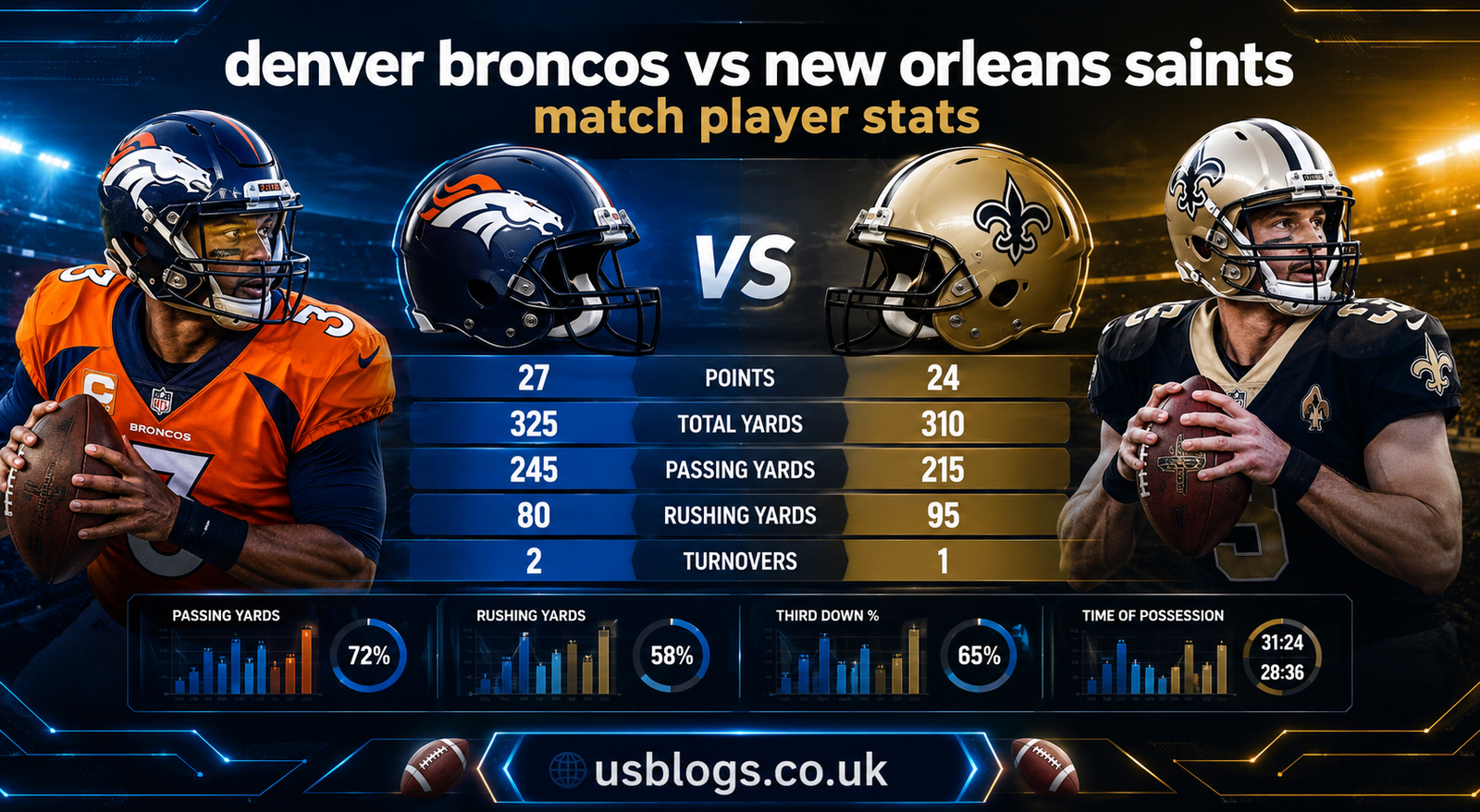
Denver Broncos vs New Orleans Saints Match Player Stats at a Glance
The numbers tell the story of a game in which Denver steadily took control rather than relying on one spectacular offensive performance. The Broncos produced 389 total yards, including 225 rushing yards, while the Saints finished with 271 total yards. Denver also controlled possession for 33:16, compared with 26:44 for New Orleans.
The Broncos’ ability to stay productive on the ground was one of the biggest differences between the teams. Denver’s rushing attack repeatedly moved the chains and allowed the offense to play from favorable situations. That approach also reduced the pressure on rookie quarterback Bo Nix, who contributed heavily as a runner.
Bo Nix Player Stats Against the Saints
Bo Nix produced a balanced performance in one of the most important games of his rookie season. The Denver quarterback completed 16 of 26 passes for 164 yards, without throwing an interception or losing a fumble. His passing numbers were modest, but his contribution on the ground made the overall performance much more impressive.
Nix rushed 10 times for 75 yards, averaging 7.5 yards per carry. His longest run covered 32 yards, giving Denver an important dimension that the Saints defense struggled to contain. He became the first rookie quarterback to rush for at least 75 yards in a prime-time game, according to the Broncos.
Another important detail was Nix’s protection. He was not sacked during the contest and did not commit a turnover. With Denver establishing the running game early, Nix only attempted five passes in the second half as the Broncos concentrated on protecting their advantage.
Javonte Williams Led the Broncos Running Game
Javonte Williams was arguably the biggest offensive star for Denver. He carried the ball 14 times for 88 yards, averaging 6.3 yards per attempt, and scored two touchdowns. His performance gave the Broncos the physical rushing presence they needed throughout the evening.
Williams’ two touchdowns were particularly important because they turned Denver’s offensive pressure into points. His longest run was 20 yards, while he also contributed three receptions for 23 yards. That gave him 111 total yards from scrimmage and made him a central part of Denver’s offensive game plan.
The Broncos did not depend entirely on Williams, either. Jaleel McLaughlin added 35 rushing yards on four attempts, while Audric Estimé recorded 29 yards on five carries. Together with Nix’s rushing production, the backfield helped Denver finish with 225 rushing yards.
Denver Broncos Receiving Statistics
Denver’s passing production was spread among several players rather than concentrated on one receiver. Troy Franklin led the team with five receptions for 50 yards, while Lucas Krull caught three passes for 41 yards. Javonte Williams added three receptions for 23 yards.
Devaughn Vele recorded one reception for 20 yards, while Marvin Mims Jr. caught two passes for 18 yards. Lil’Jordan Humphrey contributed two catches for 12 yards. The distribution showed that Nix was able to use several targets without needing to force the football into tight coverage.
Although Denver did not produce a huge passing total, the passing game served its purpose. The Saints had difficulty stopping the Broncos’ combination of short throws, quarterback runs, and inside rushing attempts. That balance helped Denver maintain possession and repeatedly put the Saints defense under pressure.
Spencer Rattler’s Numbers for New Orleans
Spencer Rattler made his second NFL start for the Saints because Derek Carr was sidelined with an oblique injury. Rattler completed 25 of 35 passes for 172 yards, giving him a 71.4 percent completion rate. He did not throw a touchdown or interception, but he lost two fumbles during the game.
Rattler also rushed five times for 34 yards, including a 28-yard run. His passing efficiency was not enough to overcome Denver’s defensive pressure, however. He was sacked six times, and one of his lost fumbles was returned for a touchdown late in the fourth quarter.
Jake Haener replaced Rattler for the Saints’ final possession. Haener completed three of four passes for 38 yards and threw a 12-yard touchdown pass to Cedrick Wilson Jr. with 1:22 remaining. It was the first touchdown pass of Haener’s NFL career.
Alvin Kamara’s Stats Were Surprisingly Quiet
Alvin Kamara entered the matchup as one of the Saints’ most important offensive players, but Denver’s defense kept him unusually quiet. Kamara carried seven times for only 10 yards and caught six passes for 14 yards. That gave him just 24 total yards from scrimmage.
The limited rushing production was particularly significant because Denver’s defensive front consistently prevented Kamara from finding running room. His longest rushing gain was only six yards. Even when the Saints used him as a receiver, the Broncos generally limited his opportunities after the catch.
Kamara’s struggles also reflected the broader circumstances surrounding the Saints offense. New Orleans entered the game without starting quarterback Derek Carr, top receivers Chris Olave and Rashid Shaheed, Taysom Hill, and several offensive linemen. Those absences severely reduced the number of established playmakers available to Rattler.
Saints Receiving Player Stats
Cedrick Wilson Jr. emerged as New Orleans’ leading receiver. He caught six passes for 57 yards and scored the Saints’ only touchdown on Haener’s late fourth-quarter pass. His 57 receiving yards accounted for a significant portion of the team’s limited passing production.
Mason Tipton also caught six passes, finishing with 45 yards. Foster Moreau added two receptions for 38 yards, including a 32-yard catch that represented one of the Saints’ better explosive plays of the night. Bub Means contributed three catches for 37 yards.
The Saints’ receiving production looked respectable in isolation, but it did not translate into sustained scoring drives. Denver’s defense repeatedly forced New Orleans into difficult down-and-distance situations, limiting the Saints’ ability to create consistent offensive momentum.
Denver’s Defense Changed the Game
The most important aspect of the Denver Broncos vs New Orleans Saints match player stats may have been the defensive numbers. Denver allowed only 271 total yards and held New Orleans to 97 rushing yards. The Broncos also recorded six sacks against Rattler.
Cody Barton delivered one of the game’s most memorable defensive plays. He recovered a Rattler fumble and returned it for a touchdown, giving Denver an additional seven points and turning another Saints offensive mistake into a scoring opportunity.
Denver’s defense also benefited from the Saints’ depleted lineup. Without Olave, Shaheed, Hill, and multiple offensive linemen, New Orleans lacked both depth and continuity. The Broncos took advantage by generating pressure and forcing the Saints to operate with a much narrower offensive playbook.
Team Statistics Show Denver’s Control
The final score of 33–10 does not fully capture how thoroughly Denver controlled the game. The Broncos generated 389 total net yards compared with 271 for New Orleans, while also holding a significant time-of-possession advantage. Denver’s offense recorded 225 rushing yards and 164 passing yards.
The Saints managed only 97 rushing yards and 174 passing yards from their quarterbacks. Their inability to establish a reliable running game meant Rattler faced increasing pressure as Denver’s lead grew. The six sacks were a major indicator of how effectively Denver’s defensive front dictated the contest.
Denver also avoided the kind of offensive mistakes that could have allowed New Orleans to regain momentum. Nix finished without a turnover, while the Broncos consistently converted their possession opportunities into points. That combination of ball security, rushing efficiency, and defensive pressure produced a comfortable road victory.
Key Takeaways for Broncos Fans
For Broncos fans, Bo Nix’s performance offered another encouraging sign during his first NFL season. His 164 passing yards were not eye-catching, but adding 75 rushing yards demonstrated his ability to influence the game beyond traditional quarterback statistics. His clean turnover-free performance was equally valuable.
Javonte Williams also provided a strong reminder of what Denver’s offense could look like when the rushing attack is effective. His 88 yards and two touchdowns gave the Broncos a reliable foundation, while Nix’s mobility made the ground game even harder for New Orleans to defend.
The defensive performance may have been the biggest reason for optimism. Holding the Saints to 10 points, recording six sacks, limiting Kamara to 24 scrimmage yards, and creating a defensive touchdown showed that Denver could win games through pressure and field position rather than depending entirely on explosive passing.
Key Takeaways for Saints Fans
Saints fans had plenty of reasons to be disappointed with the result, but the context matters. New Orleans was operating with a heavily depleted offense, forcing rookie Spencer Rattler into another start against a Denver defense that was playing with confidence. The Saints’ five-game losing streak also made the defeat particularly difficult.
Rattler’s 25 completions on 35 attempts showed that he could move the football through the air, but the six sacks and two lost fumbles demonstrated how difficult the evening became under pressure. The late touchdown from Haener to Wilson provided one positive moment, but it arrived after the outcome was effectively decided.
The biggest lesson was the importance of roster health. Missing multiple starting offensive players left New Orleans without enough reliable options to consistently challenge Denver. The Saints needed explosive plays from Kamara and their young receivers, yet Denver successfully prevented those opportunities.
Why This Game Still Matters
The Denver Broncos vs New Orleans Saints match player stats remain interesting because the game represented a significant moment in both teams’ 2024 seasons. Denver improved to 4–3 and won four of its previous five games, while New Orleans fell to 2–5 after five consecutive defeats.
For Sean Payton, the victory carried an additional layer of significance. He had previously coached the Saints from 2006 through 2021 and led the franchise to its first Super Bowl title. Returning to the Caesars Superdome and leaving with a 33–10 victory made the night memorable for Denver and particularly painful for New Orleans.
Looking at the individual numbers, the victory was built on complementary football. Nix supplied mobility and mistake-free quarterback play, Williams powered the running attack, and Denver’s defense consistently disrupted Rattler. Meanwhile, New Orleans struggled to compensate for its missing starters.
Final Thoughts on Denver Broncos vs New Orleans Saints Match Player Stats
The final 33–10 score accurately reflected Denver’s superiority on the night. The Broncos rushed for 225 yards, held the Saints to 97 rushing yards, controlled possession, and created multiple game-changing defensive plays. Those numbers explain why Denver was able to win comfortably without needing a huge passing performance from Nix.
For individual performances, Javonte Williams stands out with 88 rushing yards and two touchdowns, while Bo Nix’s 164 passing yards and 75 rushing yards provided a valuable dual-threat contribution. On the Saints side, Cedrick Wilson Jr. led the receiving group with 57 yards and a touchdown, while Alvin Kamara was held to only 24 total yards.
Ultimately, the game was decided by execution, depth, and defensive pressure. The Denver Broncos took advantage of their opportunities and maintained control for most of the evening, while the Saints struggled to overcome injuries and turnovers. For fans looking back at this matchup, the player statistics provide a clear picture of why Denver walked away with one of its most convincing victories of the season.
Read more: Ivan Cornejo Height: The Number Fans Want to Know