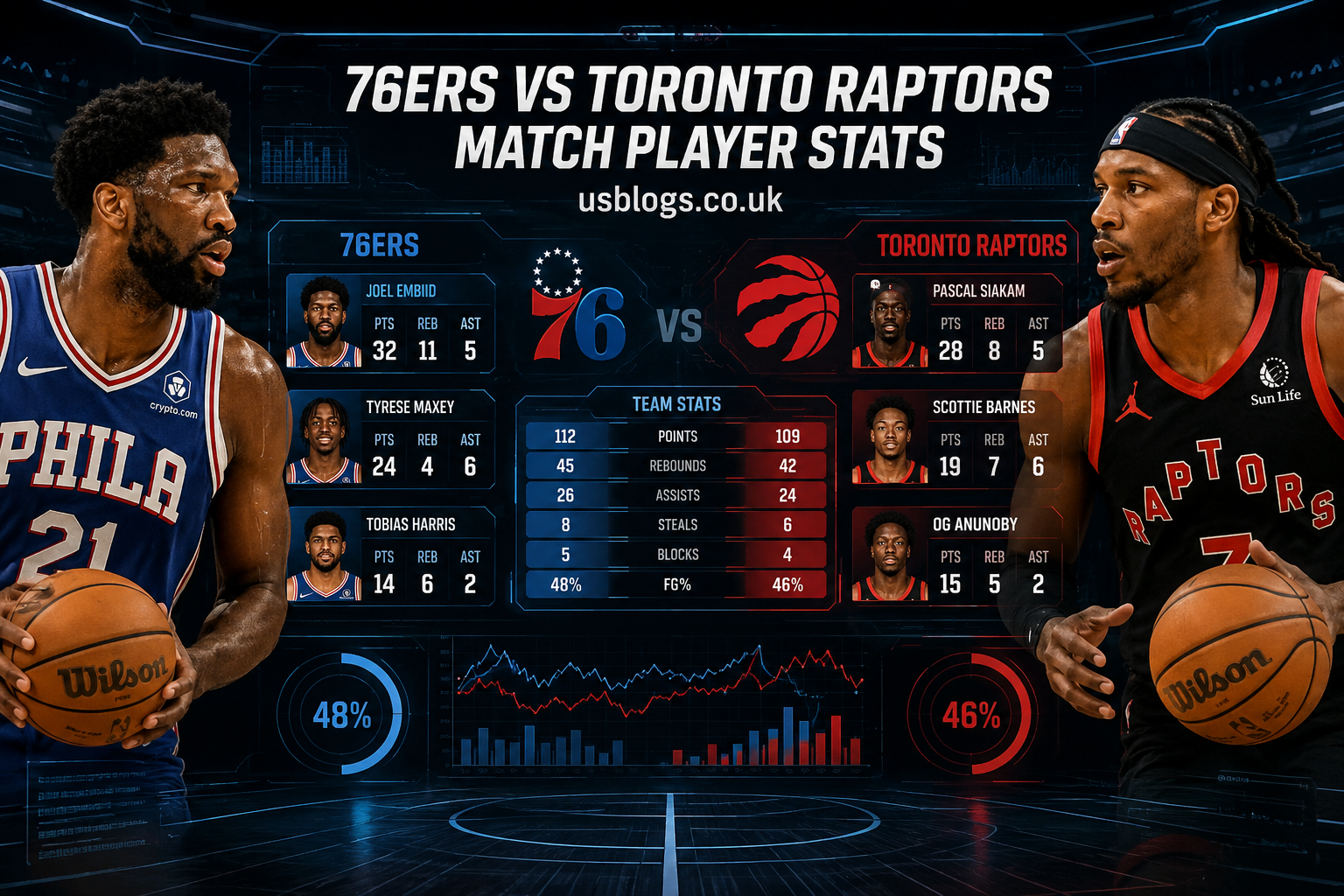
The 76ers vs Toronto Raptors match player stats from January 12, 2026, tell the story of a Philadelphia team that started extremely fast and held on for a 115-102 victory in Toronto. Tyrese Maxey led all scorers with 33 points, while Joel Embiid added 27 points and eight rebounds. Philadelphia built an enormous advantage during the opening half and then managed Toronto’s second-half response to secure the win.
| Quick Game Bio | Details |
|---|---|
| Teams | Philadelphia 76ers vs Toronto Raptors |
| Date | January 12, 2026 |
| Venue | Scotiabank Arena, Toronto |
| Final Score | 76ers 115, Raptors 102 |
| Top Scorer | Tyrese Maxey – 33 points |
| Top Rebounder | Joel Embiid – 8 rebounds |
| Top Assist Leader | VJ Edgecombe – 8 assists |
| Biggest Lead | Philadelphia by 33 |
76ers vs Toronto Raptors Match Player Stats at a Glance
The final score shows a 13-point Philadelphia victory, but the game was effectively shaped during the first half. The 76ers scored 45 points in the opening quarter and followed that with 35 in the second, taking an 80-51 lead into halftime. Toronto improved after the break, scoring 26 points in the third and 25 in the fourth, but the early deficit was too large to overcome.
Maxey was the centerpiece of Philadelphia’s offense. He finished with 33 points on 10-of-16 shooting, including 6-of-9 from three-point range, while also converting all seven of his free-throw attempts. His 62.5 percent field-goal shooting and 66.7 percent three-point shooting made him exceptionally efficient throughout the contest.
Embiid provided the interior scoring and rebounding that complemented Maxey’s perimeter production. The Philadelphia center scored 27 points on 9-of-17 shooting and went a perfect 8-for-8 from the free-throw line. He also collected eight rebounds, four assists, and two steals while playing 35 minutes and 43 seconds.
Tyrese Maxey Leads the 76ers With 33 Points
Among the 76ers vs Toronto Raptors match player stats, Maxey’s scoring performance stands out immediately. He made 10 of 16 field-goal attempts and connected on six three-pointers, giving Toronto a difficult defensive assignment from the opening minutes. His combination of pull-up shooting, perimeter range, and free-throw efficiency helped Philadelphia establish control.
Maxey also finished with four rebounds, two assists, one steal, and only one turnover. His plus-minus of +13 reflected the team’s strong performance during his minutes. The scoring guard’s ability to generate points without excessive turnovers was particularly valuable because Philadelphia created such a substantial first-half cushion.
The performance was also notable because Maxey had scored 38 points in the previous night’s overtime loss against Toronto. He therefore produced back-to-back high-scoring performances during the two-game sequence, showing how central he was to Philadelphia’s offensive attack.
Joel Embiid’s Complete Statistical Contribution
Embiid’s 27 points made him the second-highest scorer for Philadelphia, but his influence went beyond scoring. He grabbed eight total rebounds, including two offensive boards, and contributed four assists and two steals. His 52.9 percent shooting from the field helped Philadelphia maintain efficient production around the basket.
One particularly important part of Embiid’s performance was his free-throw shooting. He attempted eight free throws and made every one, allowing him to add points efficiently whenever Toronto’s defense became physical. He also committed seven turnovers, which was one of the less positive elements of his otherwise productive night.
Embiid and Maxey combined for 60 points, giving Philadelphia a dominant one-two scoring combination. The official NBA recap specifically highlighted their combined output as a major reason the 76ers were able to defeat Toronto.
VJ Edgecombe Provides Efficient Support
VJ Edgecombe delivered one of the most efficient performances in the 76ers vs Toronto Raptors match player stats. He scored 15 points while shooting 5-of-7 from the field and an outstanding 5-of-6 from three-point range. That 83.3 percent accuracy from beyond the arc was a major weapon for Philadelphia.
Edgecombe also led Philadelphia with eight assists, giving him an important role as both a scorer and facilitator. He added two rebounds and one steal during 33 minutes and 29 seconds of action. His plus-minus was +8, showing that his minutes were generally productive for the 76ers.
His perimeter shooting helped stretch Toronto’s defense. With Maxey also making six three-pointers, Philadelphia had multiple guards capable of punishing defensive mistakes from outside. That spacing contributed to the huge scoring output during the opening half.
Paul George Adds a Balanced Performance
Paul George scored 15 points for Philadelphia and added six assists and four rebounds. He shot 5-of-13 from the field and made one of his six three-point attempts. Although his outside shooting was not especially efficient, his playmaking helped connect Philadelphia’s primary scorers with the rest of the offense.
George also returned to the lineup after missing the previous night’s game. His presence gave Philadelphia another experienced ball-handler and perimeter defender, while his six assists demonstrated his ability to contribute without relying solely on scoring.
The 76ers therefore received meaningful production from several different positions. Maxey and Embiid carried most of the scoring burden, while Edgecombe and George supplied playmaking and additional perimeter options.
Toronto Raptors Player Stats and Top Performers
Toronto’s best scorer was Immanuel Quickley, who finished with 18 points. He shot 8-of-18 from the field and made two three-pointers, but his three-point shooting was only 20 percent. He also recorded six rebounds and one steal during more than 32 minutes of action.
Brandon Ingram contributed 17 points, ten rebounds, and seven assists, making him one of Toronto’s most versatile players. He struggled from the field, making only five of 15 attempts, but his rebounding and playmaking helped Toronto remain competitive after halftime.
Scottie Barnes added 15 points, four rebounds, and three assists. His shooting was difficult throughout the night, as he converted only five of 16 field-goal attempts and missed all three of his attempts from three-point range. Still, he remained an important part of Toronto’s offensive and defensive structure.
Collin Murray-Boyles Makes an Impact
Collin Murray-Boyles produced an efficient performance for the Raptors. He scored 12 points on 6-of-9 shooting and collected seven rebounds. He also contributed six assists and two steals, demonstrating a broad statistical impact despite Toronto’s defeat.
His 66.7 percent field-goal shooting was among Toronto’s best marks in the game. Murray-Boyles also provided valuable work on the offensive glass, collecting four offensive rebounds and helping Toronto create additional opportunities around the basket.
Jamal Shead contributed six assists despite scoring only three points. His passing was particularly useful as Toronto attempted to recover from Philadelphia’s huge first-half advantage, although the Raptors ultimately could not close the gap.
Shooting Efficiency Made the Difference
One of the clearest lessons from the 76ers vs Toronto Raptors match player stats is the difference in perimeter shooting. Maxey and Edgecombe combined to make 11 three-pointers, while Toronto’s primary scorers struggled to generate the same production from outside.
Philadelphia’s offensive efficiency was especially important during the first half. The 76ers scored 80 points before halftime, creating a 29-point advantage that forced Toronto to play catch-up for the remainder of the contest.
Toronto actually scored more points in the paint, 54 compared with Philadelphia’s 38, and also recorded more fast-break points. Those advantages were not enough because the Raptors could not match Philadelphia’s early perimeter scoring and overall offensive explosion.
Rebounding and Playmaking Numbers
The rebounding battle was relatively competitive, with Philadelphia finishing with 49 total rebounds and Toronto recording 50. Toronto’s 11 offensive rebounds helped generate second-chance opportunities, while Philadelphia’s interior players worked to limit the damage.
Playmaking was another important area. Edgecombe led Philadelphia with eight assists, while George contributed six. Toronto received seven assists from Ingram, six from Murray-Boyles, and six from Shead, giving the Raptors several capable distributors.
The difference came from how effectively those possessions were converted into points. Philadelphia’s early offensive rhythm produced a massive lead before Toronto’s passing and interior scoring could make a meaningful difference.
How the Game Changed After Halftime
The second half looked dramatically different from the opening 24 minutes. Philadelphia scored only 19 points in the third quarter and 16 in the fourth, allowing Toronto to gradually reduce the deficit. The Raptors scored 51 second-half points compared with Philadelphia’s 35.
Despite that momentum shift, Toronto’s comeback never became realistic because Philadelphia had already created a 29-point halftime advantage. The 76ers controlled the game long enough to protect their lead, even as their offensive production declined substantially after the break.
The final 115-102 score therefore reflects two different games within the same contest: a dominant Philadelphia first half followed by a much more competitive Toronto second half.
What the 76ers vs Toronto Raptors Match Player Stats Show
The numbers demonstrate that Philadelphia’s victory was driven primarily by elite scoring efficiency from Maxey, strong interior production from Embiid, and excellent three-point shooting from Edgecombe. Their combined offensive contributions gave the 76ers enough firepower to survive Toronto’s second-half push.
For Toronto, Ingram’s all-around production, Quickley’s scoring, and Murray-Boyles’ efficient offense were encouraging. However, Barnes and several other Raptors struggled with their shooting, making it difficult to recover from the disastrous opening half.
The matchup was also part of a remarkable two-game sequence between the teams. Toronto had won the January 11 meeting 116-115 in overtime, with Barnes scoring 31 points and Maxey scoring 38 for Philadelphia. One night later, Philadelphia responded with a 115-102 victory.
Final Takeaway for Basketball Fans
The 76ers vs Toronto Raptors match player stats from January 12, 2026, highlight how quickly an NBA game can be decided by shooting efficiency and early offensive execution. Maxey’s 33 points led the way, while Embiid’s 27 points and eight rebounds gave Philadelphia a dependable inside presence.
Edgecombe’s 15 points and eight assists were equally significant because his five made three-pointers created additional spacing around Philadelphia’s stars. George added six assists and 15 points, giving the 76ers enough secondary production to maintain control.
Toronto showed considerable resilience after halftime, but the 80-51 first-half deficit was ultimately decisive. The Raptors’ stronger second half could not erase Philadelphia’s early advantage, leaving the 76ers with a 115-102 victory and an important response after their overtime defeat the previous evening.
Read more: Denver Broncos vs New Orleans Saints Match Player Stats: Complete Game Breakdown