
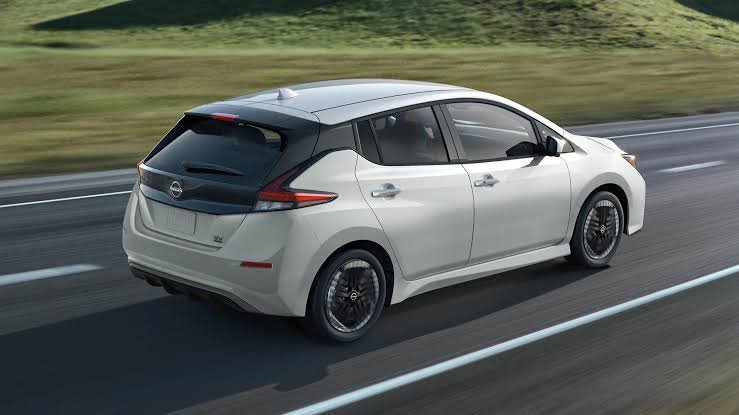
The 2024 Nissan Leaf remains one of the most recognizable names in the electric-car market. Nissan introduced the Leaf years before electric vehicles became mainstream, giving the model a long history in affordable EV transportation.
For 2024, the Leaf continues as a practical choice for drivers who want electric power without moving into a much larger or more expensive vehicle. Its compact dimensions, quiet operation, simple controls, and available driver-assistance technology make it appealing for everyday driving.
| Quick Facts | 2024 Nissan Leaf |
|---|---|
| Vehicle Type | Electric hatchback |
| Seating Capacity | 5 passengers |
| Powertrain | Battery-electric |
| Standard Battery | 40 kWh |
| Available Battery | 62 kWh |
| EPA Range | Up to 212 miles |
| Drive Type | Front-wheel drive |
| Charging | AC and DC fast charging |
| Body Style | Five-door hatchback |
2024 Nissan Leaf Design and Exterior
The exterior of the 2024 Nissan Leaf has a clean, aerodynamic shape that reflects its electric identity without looking excessively futuristic. The sharp front styling, compact body, and distinctive rear design help the Leaf stand apart from conventional hatchbacks.
Nissan also gives the Leaf a relatively manageable footprint for urban environments. Its size can be useful in crowded streets and parking areas where a larger electric crossover may feel unnecessarily bulky.
The Leaf’s aerodynamic body is not simply about appearance. Reducing aerodynamic resistance is important for an electric vehicle because efficiency directly affects how much usable distance can be obtained from the battery.
2024 Nissan Leaf Battery and Electric Range
The 2024 Nissan Leaf is available with two battery configurations depending on the trim. The entry-level Leaf S uses a 40-kWh battery, while the Leaf SV Plus receives a larger 62-kWh battery.
The smaller battery provides an EPA-estimated range of up to 149 miles. The larger battery increases the official range to as much as 212 miles, making the SV Plus considerably more suitable for drivers who regularly travel longer distances.
Actual range can vary considerably in everyday use. Weather, driving speed, road conditions, temperature, climate-control use, and driving habits can all influence how efficiently the Leaf uses stored electricity.
For many commuters, the standard battery can still provide sufficient range for routine journeys. Drivers with longer commutes or fewer charging opportunities may find the 62-kWh version more comfortable.
2024 Nissan Leaf Performance
The Leaf is designed around smooth and predictable electric performance rather than aggressive sports-car acceleration. Electric motors deliver torque quickly, allowing the vehicle to move away from traffic lights without the hesitation associated with some traditional gasoline engines.
The standard Leaf produces 147 horsepower and 236 lb-ft of torque. The SV Plus uses a more powerful motor producing 214 horsepower and 250 lb-ft of torque.
That additional output makes the SV Plus noticeably stronger when accelerating onto highways or passing slower traffic. Nevertheless, the Leaf remains primarily a practical commuter rather than a performance-focused EV.
One of the biggest advantages of electric propulsion is refinement. There is no conventional engine vibration or gear-shifting sensation, so the Leaf can feel particularly smooth during low-speed city driving.
2024 Nissan Leaf Interior and Comfort
Inside, the 2024 Nissan Leaf provides a straightforward cabin designed around everyday usability. The seating position gives occupants a familiar driving environment, while the dashboard incorporates modern screens and controls without becoming excessively complicated.
The cabin can accommodate up to five occupants, although rear-seat comfort is naturally more limited than in a larger SUV or crossover. For small families and daily commuting, the available space is generally practical.
The Leaf also offers useful cargo capacity for a compact vehicle. Folding the rear seats expands the available cargo area, allowing owners to carry larger items when necessary.
Material quality varies according to trim and equipment, but the overall cabin emphasizes functionality. Drivers looking for a quiet and uncomplicated electric vehicle may appreciate this approach.
Technology Inside the 2024 Nissan Leaf
Technology is an important part of the 2024 Nissan Leaf experience. Depending on the trim, equipment can include a touchscreen infotainment system, smartphone connectivity, navigation-related functions, and other connected features.
Apple CarPlay and Android Auto compatibility help drivers access familiar smartphone applications through the vehicle’s infotainment system. This reduces the learning curve for people switching from a conventional car to an EV.
Higher equipment levels can also provide additional convenience features. The exact equipment depends on the selected trim, so buyers should compare the standard and optional features before choosing a particular Leaf.
The technology package is not intended to overwhelm the driver. Instead, Nissan focuses on integrating commonly used functions into a relatively familiar dashboard layout.
2024 Nissan Leaf Safety Features
Safety remains an important consideration when choosing any modern vehicle. The 2024 Nissan Leaf includes a range of active and passive safety technologies designed to assist the driver and protect occupants.
Available driver-assistance technology includes Nissan’s ProPILOT Assist system. This technology can help with steering, acceleration, and braking in certain driving situations when the system’s operating conditions are met.
Other available safety features can include automatic emergency braking, lane-departure warnings, blind-spot monitoring, rear cross-traffic alert, and other electronic assistance systems.
These systems should be viewed as driver aids rather than substitutes for attentive driving. The driver remains responsible for controlling the vehicle and responding to changing road conditions.
2024 Nissan Leaf Charging
Charging is one of the most important differences between owning a Leaf and driving a gasoline-powered vehicle. The Leaf can be charged using AC power at home or at compatible public charging stations.
For many owners, overnight home charging can cover the majority of daily driving needs. This approach can make EV ownership particularly convenient because the vehicle can start the day with a substantial charge without visiting a fuel station.
The Leaf also supports DC fast charging. Fast charging can be useful during longer trips when the battery needs additional energy within a shorter period.
Charging performance depends on the battery version, charger, battery temperature, state of charge, and other conditions. Drivers planning frequent road trips should consider charging infrastructure along their regular routes.
Driving the 2024 Nissan Leaf Every Day
The 2024 Nissan Leaf works particularly well in an urban and suburban environment. Its compact dimensions make it easy to maneuver, while the instant torque of the electric motor provides responsive acceleration in normal traffic.
Regenerative braking can also help recover some energy when the vehicle slows down. Depending on the selected settings and driving conditions, this can make one-pedal-style driving possible and reduce the need to use the conventional brake pedal.
The quiet cabin is another advantage during daily use. Without a gasoline engine constantly running, low-speed driving can feel remarkably calm, especially in traffic.
However, drivers who frequently travel long highway distances should plan their charging stops carefully. The Leaf’s maximum range is useful for many journeys, but it does not provide the same long-distance flexibility as some newer EVs with larger batteries and faster charging systems.
2024 Nissan Leaf Pricing and Value
The 2024 Nissan Leaf was positioned as one of the more accessible ways to enter the electric-vehicle market. Pricing varies by trim, destination charges, available equipment, taxes, incentives, and the buyer’s location.
The standard Leaf S generally offers the lowest entry price, while the SV Plus costs more because of its larger battery and stronger electric motor. Buyers need to decide whether the additional range and performance justify the higher purchase price.
Ownership costs can also be an important part of the value equation. Electric vehicles do not require conventional engine oil changes, and their electric drivetrains have fewer moving components than traditional combustion engines.
Energy costs can also be lower for some drivers, particularly when charging primarily at home. However, electricity prices, insurance, tire costs, local incentives, and maintenance requirements should all be considered before making a purchase.
Is the 2024 Nissan Leaf Good for Families?
For smaller families, the Leaf can be a practical second vehicle or primary commuter. Five seats, useful cargo space, a quiet cabin, and simple electric operation give it several qualities that work well for everyday transportation.
Its biggest limitation for family road trips is charging and range. A family that regularly travels hundreds of miles may prefer an EV with greater range and a newer fast-charging architecture.
For school runs, shopping, commuting, and local travel, however, the Leaf can make considerable sense. The right choice ultimately depends on how far the vehicle needs to travel between charging opportunities.
2024 Nissan Leaf vs. Newer Electric Cars
The 2024 Nissan Leaf has the advantage of an established design and a relatively familiar driving experience. It can be attractive to buyers who prioritize affordability and straightforward electric transportation over having the newest technology.
At the same time, the EV market has changed rapidly. Newer electric vehicles increasingly offer longer ranges, larger displays, faster charging, more spacious interiors, and modern vehicle platforms.
That does not make the Leaf irrelevant. Instead, it places the vehicle into a particular niche: a compact and relatively accessible EV for drivers whose daily transportation requirements are predictable.
Buyers should therefore compare the Leaf against newer electric hatchbacks, sedans, and crossovers before making a final decision. Range, charging speed, purchase price, equipment, and local charging availability can make a major difference.
2024 Nissan Leaf: Final Verdict
The 2024 Nissan Leaf continues to represent a straightforward approach to electric mobility. Its two battery choices, quiet electric motor, practical hatchback body, available driver-assistance technology, and manageable dimensions make it suitable for many daily driving situations.
The 40-kWh version is best suited to drivers with predictable shorter journeys, while the 62-kWh SV Plus provides considerably more range and stronger performance. Choosing between them largely depends on how frequently the vehicle will be driven over longer distances.
The Leaf is not the newest or most technologically ambitious EV available today. Its strength is its simplicity and established electric-car formula.
For commuters and households looking for a practical electric hatchback, the 2024 Nissan Leaf remains a vehicle worth considering. Understanding its range, charging requirements, equipment, and everyday limitations is the key to determining whether it fits a particular driver’s needs.
Read more: How Old Is Ash Trevino? Age, Birthday, Biography, Career, and Life