
Introduction to the Incandescent Light Bulb
The incandescent light bulb is one of the most recognizable inventions in modern history. For more than a century, it has been used in homes, shops, offices, streets, and public buildings around the world. Even today, when newer lighting technologies like LED and CFL bulbs are widely available, many people still remember the warm glow of an incandescent bulb as the standard image of a light bulb.
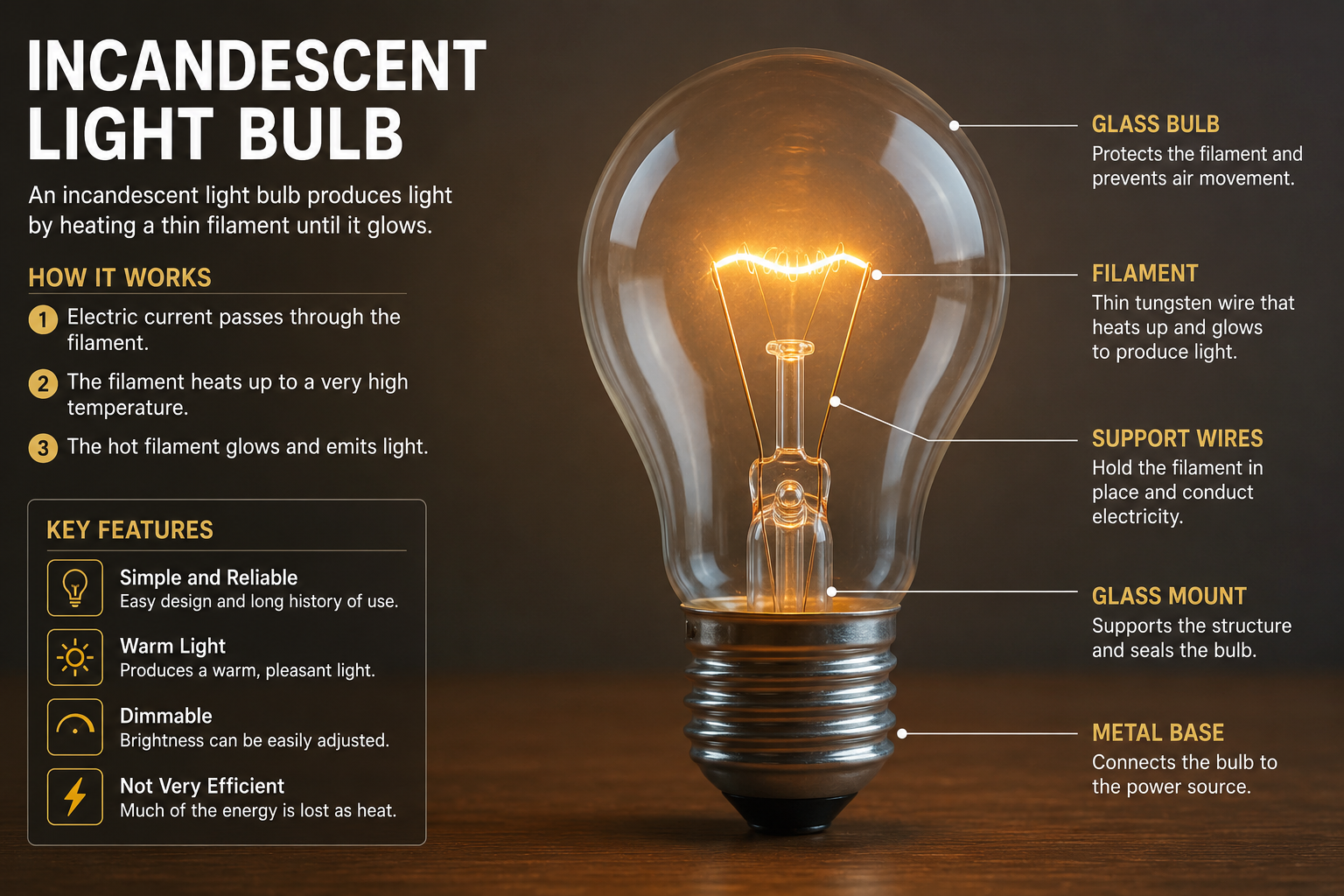
An incandescent light bulb works in a very simple but clever way. Inside the glass bulb, there is a thin wire called a filament. When electricity passes through this filament, it becomes extremely hot and begins to glow. That glowing filament produces light. This process is called incandescence, which simply means producing light through heat.
What makes the incandescent light bulb special is not only its history but also the type of light it produces. It gives off a warm, soft, and comfortable glow that many people find pleasant. Although it is not the most energy-efficient option today, it still holds an important place in the story of lighting and technology.
How an Incandescent Light Bulb Works
The working principle of an incandescent light bulb is based on heating a metal filament until it glows. The filament is usually made of tungsten because tungsten can handle very high temperatures without melting quickly. When electrical current flows through the filament, resistance causes it to heat up. As the temperature rises, the filament starts to emit visible light.
The glass bulb around the filament is also important. If the filament were exposed directly to air, it would burn out almost instantly because oxygen would react with the hot metal. To prevent this, the glass bulb is either filled with an inert gas or has most of the air removed. Common gases used inside incandescent bulbs include argon and nitrogen. These gases help protect the filament and extend the life of the bulb.
Even though the design looks simple from the outside, every part of the incandescent light bulb has a purpose. The metal base connects the bulb to the electrical socket. The support wires hold the filament in place. The glass envelope protects the internal parts. Together, these components allow the bulb to produce steady light when connected to electricity.
History of the Incandescent Light Bulb

The history of the incandescent light bulb is often connected with Thomas Edison, but the full story involves many inventors. Before Edison created his practical version, several scientists and inventors had already experimented with electric light. The challenge was not just to make a bulb glow, but to make it last long enough and be affordable enough for everyday use.
Thomas Edison’s major achievement was creating a reliable and commercially useful incandescent light bulb. He improved the filament, the vacuum inside the bulb, and the overall electrical system needed to power it. His work helped bring electric lighting into homes and businesses, changing daily life in a major way. People no longer had to rely only on candles, oil lamps, or gas lamps after sunset.
The incandescent light bulb quickly became a symbol of progress. It extended working hours, improved safety, and made indoor spaces more comfortable. Streets became brighter, factories became more productive, and homes became easier to live in at night. In many ways, this simple bulb helped shape the modern world.
Main Parts of an Incandescent Light Bulb
An incandescent light bulb may seem like a basic object, but it has several important parts. The most visible part is the glass bulb, also known as the envelope. This glass covering protects the filament and keeps the internal environment stable. It also helps spread the light evenly across a room.
The filament is the heart of the bulb. It is usually made from tungsten because of its high melting point and durability under extreme heat. The filament is often coiled to increase its length while keeping the bulb compact. When electricity passes through it, the filament becomes hot enough to glow brightly.
The base of the bulb is another key part. Most household incandescent bulbs have a screw base that fits into a standard socket. The base allows electricity to enter the bulb and complete the circuit. Inside the bulb, support wires and lead-in wires hold the filament in position and carry electrical current to it. Each small part plays a role in making the bulb function properly.
Advantages of the Incandescent Light Bulb
One of the biggest advantages of the incandescent light bulb is its warm and natural-looking light. Many people prefer this type of light because it feels cozy and relaxing. It works especially well in bedrooms, living rooms, restaurants, and spaces where comfort matters more than brightness alone.
Another benefit is instant brightness. When you switch on an incandescent light bulb, it reaches full brightness immediately. There is no warm-up time, flickering delay, or slow increase in light output. This makes it convenient for places where quick lighting is needed, such as closets, hallways, bathrooms, and staircases.
Incandescent bulbs are also simple and inexpensive to buy. For many years, they were the cheapest option available in stores. They do not require complicated circuits or special fixtures. Their simple design makes them easy to use, easy to replace, and compatible with many older lamps and lighting systems.
Disadvantages of the Incandescent Light Bulb
The main disadvantage of an incandescent light bulb is low energy efficiency. Most of the electricity it uses is converted into heat rather than visible light. This means the bulb consumes more power compared to modern alternatives like LED bulbs. As a result, using many incandescent bulbs can increase electricity bills.
Another drawback is the short lifespan. A typical incandescent light bulb does not last as long as an LED or even a compact fluorescent bulb. The filament slowly weakens over time, and eventually it breaks. When that happens, the bulb stops working and needs to be replaced. This can be inconvenient and more costly in the long run.
Heat production is also a concern. Since incandescent bulbs become very hot during operation, they can raise the temperature in small spaces. They must be handled carefully after use because touching a hot bulb can cause burns. In some situations, excessive heat from lighting can also be unsafe, especially near fabric, paper, or other flammable materials.
Incandescent Light Bulb vs LED Bulb
When comparing an incandescent light bulb with an LED bulb, the biggest difference is efficiency. LED bulbs use much less electricity to produce the same amount of light. This makes them more cost-effective over time. While an incandescent bulb may be cheaper at the time of purchase, an LED bulb usually saves more money through lower energy use and longer life.
The light quality is also different. Incandescent bulbs naturally produce a warm tone, which many people enjoy. LED bulbs are available in many color temperatures, including warm white, cool white, and daylight. This gives users more control over the mood and appearance of a room. Modern LEDs can closely copy the warm glow of incandescent bulbs.
Lifespan is another major difference. An incandescent light bulb may last around 1,000 hours, while an LED bulb can last tens of thousands of hours. This means fewer replacements and less maintenance with LED lighting. However, some people still prefer incandescent bulbs for specific uses because of their simplicity, dimming performance, and classic glow.
Common Uses of Incandescent Light Bulbs
Incandescent light bulbs have been used in many different settings. In homes, they were commonly installed in table lamps, ceiling fixtures, chandeliers, wall lights, and bathroom lights. Their warm glow made them ideal for spaces where people wanted a soft and inviting atmosphere.
They have also been used in decorative lighting. String lights, vintage lamps, and certain specialty fixtures often use incandescent bulbs because of their traditional look. The visible glowing filament can add character and charm, especially in classic or rustic interior designs. For decorative purposes, appearance can sometimes be more important than energy savings.
Incandescent bulbs are also used in some special applications where heat is useful. For example, certain appliances, heat lamps, and older equipment rely on the heat produced by incandescent bulbs. In these cases, replacing them with LED bulbs may not always be suitable because LEDs do not produce heat in the same way.
Why People Still Like Incandescent Light Bulbs
Even with the rise of energy-saving lighting, many people still like the incandescent light bulb. One reason is nostalgia. For decades, this was the standard bulb found in nearly every home. Its warm glow is connected with memories of family rooms, bedside lamps, and quiet evenings indoors.
Another reason is visual comfort. Incandescent lighting has excellent color rendering, which means colors often appear natural under its light. Skin tones, wood furniture, fabrics, and artwork can look warm and pleasant. This is one reason photographers, designers, and homeowners have appreciated incandescent lighting for many years.
Some people also prefer incandescent bulbs because they are simple. There are no electronic drivers, no complex designs, and no unusual behavior. They turn on instantly, dim smoothly, and produce predictable light. For users who value simplicity and traditional performance, the incandescent light bulb still has a certain appeal.
Energy Use and Environmental Impact
The incandescent light bulb uses more energy than most modern lighting options. Because much of its power becomes heat, it is not considered environmentally friendly by today’s standards. Higher energy use means more demand for electricity, and depending on how that electricity is produced, it can contribute to greater carbon emissions.
This is one reason many countries have encouraged or required a shift toward energy-efficient lighting. LED bulbs and other efficient options help reduce electricity consumption on a large scale. When millions of homes switch from incandescent bulbs to LEDs, the overall energy savings can be significant.
However, environmental impact is not only about electricity use. Manufacturing, disposal, lifespan, and material use also matter. Incandescent bulbs are simple and do not contain mercury, unlike some older compact fluorescent bulbs. Still, because they burn out quickly and use more power, they are generally less sustainable than modern LED lighting.
Buying an Incandescent Light Bulb
When buying an incandescent light bulb, the first thing to check is wattage. Wattage tells you how much energy the bulb uses. Common household incandescent bulbs include 40-watt, 60-watt, 75-watt, and 100-watt versions. Higher wattage usually means brighter light, but it also means more energy consumption.
The bulb shape and base type are also important. Not every bulb fits every fixture. Some bulbs have standard screw bases, while others have smaller or specialty bases. Before buying, it is smart to check the fixture requirements. Using the wrong bulb can lead to poor performance or safety issues.
You should also consider the purpose of the light. For soft room lighting, a lower-wattage incandescent bulb may be enough. For task lighting, such as reading or working, a brighter bulb may be needed. If the fixture has a dimmer switch, incandescent bulbs usually work very well because they dim smoothly and naturally.
Safety Tips for Using Incandescent Light Bulbs
Since an incandescent light bulb produces heat, safety is important. Always allow the bulb to cool before touching or replacing it. A bulb that has been on for several minutes can become hot enough to burn your fingers. Using a cloth or waiting a few minutes can help prevent injury.
It is also important not to exceed the recommended wattage for a fixture. Lamps and ceiling fixtures usually have a maximum wattage rating. If you use a bulb with higher wattage than recommended, the fixture may overheat. This can damage the socket, wiring, lampshade, or surrounding materials.
Keep incandescent bulbs away from flammable objects. Curtains, paper, plastic decorations, and fabric lampshades should not touch the bulb. Good ventilation around the bulb helps reduce heat buildup. A little caution goes a long way in keeping incandescent lighting safe and reliable.
The Future of the Incandescent Light Bulb
The future of the incandescent light bulb is much more limited than its past. In many places, energy efficiency standards have reduced the use of traditional incandescent bulbs. Stores now mainly promote LED lighting because it lasts longer and uses less electricity. For general household lighting, LEDs have become the practical choice.
Still, the incandescent light bulb has not completely disappeared. It remains useful in some specialty areas, decorative lighting, and applications where heat is needed. Some people also keep using it in older fixtures or in spaces where they prefer its warm glow. Its role may be smaller now, but it has not been erased entirely.
The biggest legacy of the incandescent light bulb is its influence. It taught the world what electric lighting could do. It changed homes, cities, workplaces, and daily routines. Even as newer technologies replace it, the incandescent bulb remains one of the most important inventions in the history of modern life.
Conclusion
The incandescent light bulb is more than just an old lighting product. It is a classic invention that helped transform the way people live and work. Its simple design, warm light, and long history make it one of the most familiar objects ever created. Even people who now use LED bulbs still recognize the iconic shape of the incandescent bulb.
At the same time, it is clear why incandescent bulbs are no longer the main choice for most homes. They use more electricity, produce more heat, and have a shorter lifespan than modern lighting options. For people who want to save energy and reduce long-term costs, LED bulbs are usually the better option.
Still, the incandescent light bulb deserves respect. It represents a major step in human innovation and remains valued for its comfort, simplicity, and warm glow. Whether used for decoration, nostalgia, or special purposes, it continues to hold a unique place in the world of lighting.